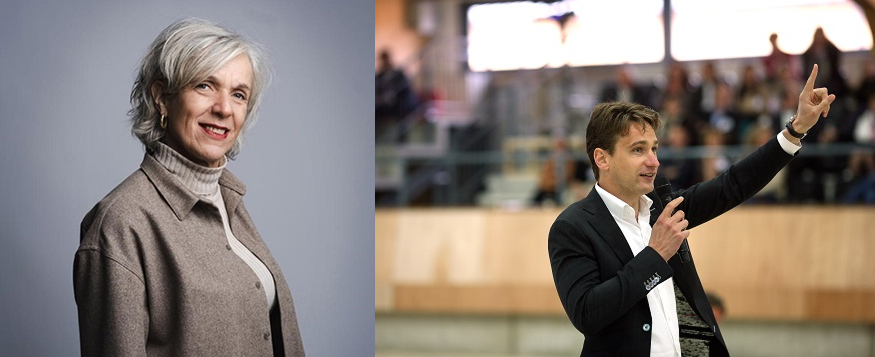
Gaining a clearer understanding that your organization is both literally and figuratively valuable, securing a theoretical foundation for what you already do intuitively, and learning to set priorities and make deliberate choices—these are just a few key takeaways participants gain from the Social Entrepreneurship Program. Marleen van der Kolk and Daniël Klijn are both past the halfway mark of the executive program and have already put much of what they've learned into practice within their respective organizations.
Background & Urgency
Three years ago, Daniël founded an organization dedicated to developing and training sports club boards. Given recent developments in both grassroots and elite sports, this has proven to be the answer to an increasingly visible and urgent issue. With twenty years of experience under his belt, Daniël isn't intimidated by the huge challenge sports clubs face today.
"How do we keep the Dutch sports infrastructure vital and healthy? In the Netherlands, we have roughly 25,000 clubs, which together rely on around 200,000—mostly volunteer—board members. Due to the privatization and commercialization of clubs since 2008, these boards collectively bear a growing responsibility. This comes with high demand for our services and requires rapid professionalization and growth within our own organization. Because I kept moving in the same circles with the same people, I looked for a space outside the field to develop myself further. Fortunately, I was still able to enroll in this program."
Marleen is the director of two foundations: Stichting Zwerfjongeren Nederland (Dutch Homeless Youth Foundation) and Stichting Bouwdepot.
"Through both foundations, we advocate for (homeless and unstably housed) young people in vulnerable positions and address the systemic issues they encounter, while working to prevent youth homelessness altogether. In The Hague, for instance, we lobby for increased focus and policy reform. Our main office is located in Utrecht, but we operate nationwide."
How to Create Impact
Marleen continues: "I came across the program through a colleague I collaborate with. He had just started the course at the time and was extremely positive about it. I had been wrestling with a few core questions for a while: as foundations, we promise to deliver impact and drive systemic breakthroughs for vulnerable youth living in precarious conditions. But what exactly is 'impact,' and how do you achieve a meaningful breakthrough? I wanted to grow professionally and exchange ideas with peers in the field. So, I started the program in January of this year."
“In this program, I'm learning to work with academic models and can better articulate why I do what I do.”
Backing Intuition with Theory
"I signed up because I wanted to deepen my understanding of social entrepreneurship," Daniël shares. "On the very first day, it dawned on me that I had actually been a social entrepreneur for twenty years... I had just been operating purely on intuition rather than a solid theoretical foundation."
"It's refreshing—a cohort where everyone represents a different sector and stage of business. That creates great opportunities to brainstorm and connect on the same wavelength."
Marleen adds: "It isn't endlessly theoretical either. You're given the core conceptual frameworks, and then you're actively encouraged to apply those lessons directly to your own organization. That's one of my favorite aspects of this course."
Generating More Value for the Enterprise
"Earning revenue," Daniël offers as an example. "If something has value, it should be paid for. Yet, I used to find it difficult to put a price tag on our services. Board members volunteer their time and receive no compensation—so how could I ask them for money? The program helped me realize that we must do this if we want to move forward and help more people. As a result, we created a strategy to link an earned revenue model to memberships for our digital learning platform, which offers courses and training for board members."
Marleen resonates with that experience: "Becoming self-sustaining is critical for any organization that wants long-term viability. If you rely entirely on subsidies, you take on significant risk and remain subject to third-party policy shifts. Building your own financial reserves prevents situations where, for example, you have to send staff home because funding ran out. On top of that, financial self-reliance means you stay in the driver's seat of your own organization."
“Financial self-reliance means you stay in the driver's seat of your own organization.”
Learning to Make Choices
"I had a major eye-opener on day one," Marleen continues. "'Governance' isn't just about board structure; it's also about your core values, how you interact with one another, each person's role in the organization, and the overarching workplace culture."
"I've also learned the importance of making clear choices. We run two foundations tackling complex societal issues with a single board, supported by a relatively small team. Where should we direct our focus to achieve maximum impact? Operational efficiency is another key focus—not as an end in itself, but because smarter process management allows us to do more. Fortunately, Rome and Paris weren't built in a day either."