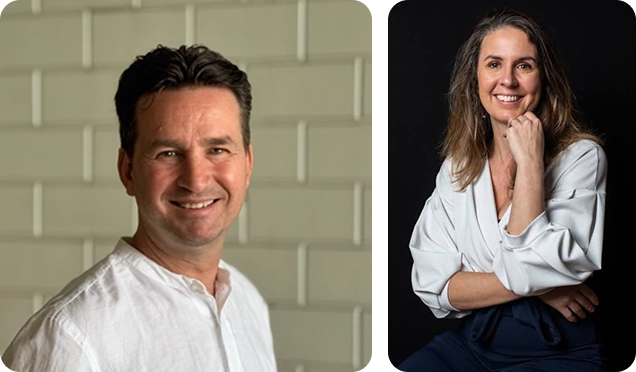
From 'on feeling' to a more theoretical basis, getting tools to ensure that the whole team shares the same mission and vision, detaching yourself from your organization for a fresh look and hands when scaling up. Laura Kistemaker from Uitelkaar.nl and Freddie Krullaars from EcoWare are now halfway through the Social Entrepreneurship Course, and already have a lot in their hands to look at a future in which their respective organizations can expand.
Asked why Laura started the course, she says: 'I heard about the course from people who had already followed it. Our company, in the legal sector, may not seem like a social enterprise at first glance, but we do. And what is the definition of 'social enterprise' actually?
“The idea that, for example, only a social workplace is a social enterprise has long been outdated. You have to get at least fifty percent of the income from the market to be called a social enterprise.”
Profit is limited, the lion's share is invested in the company. And of course you have the number one making of social impact. According to that definition, we are a real social enterprise. And in the legal field there are many opportunities to make it more human. Not just in the area in which we work now. We have the ambition to expand. To achieve that, I need a better base. And that's where the course comes into view.'
On the right track
Freddie has more or less rolled into the function. 'The then director also followed this course. That way he found out that an operational manager was needed. I was hired for that. Due to circumstances, the director withdrew and I took his place. I did a lot on my feeling. That works well so far. But we want to scale up, not to more branches across the country, but to more collaborations to get better nationwide distribution so that more people can use our services and the products. I realized it was better to get a better base. How do I do it now and do I do it right? So far I see that we are on the right track. That too is fun to learn.'
Laura can confirm that.
“The course is a kind of benchmark. What do we do well, where else can we do it, how do we do it and how can it be tighter? It's a kind of mirror for your business.”
We also want to scale up, grow in the current model. Now we still focus on the target group that deliberately wants to separate in good consultation. But there is also a large group of people who have trouble with this, or are already in conflict. We could even offer a solution to other parties dealing with social work and youth care. That requires more from our organization. That's why I started the course. What are we good at ourselves and what do we need other people for?'
Fine coaches
They both have a lot to do with their respective coaches. Freddie: 'You talk to someone on a different level, go much deeper. During the workshops it remains more general – there is no other way with participants who all come from a different organization and have a different background – but the coach knows my company better. As a result, there is more direction in the conversation and I am made to think more about certain aspects of the organization. For example, I found out that finance is not my strong point. I can work with that.'
Laura agrees. 'It's also nice to talk to someone, someone who looks along with your interest. It almost feels like a luxury. In addition, I am also well aware of our position. Not that of Uitelkaar.nl specifically, but of companies that want to make social impact. We are precursors. Actually, all companies should go in this direction, but we are far from there. That makes us innovators, pioneers.
“If we show that it is possible, it will become more attractive for other companies and organizations to follow our direction. This makes our organization part of a new movement. That's a good idea.”
Teamwork
'After some workshops I think: I have to share this,' Laura continues. 'One of the first meetings was about ensuring collaboration in your team. How do you understand your team and what role do you play in it yourself? I think it's a shame if the knowledge stays with me alone, so I do my best to share it with the people in my organization as much as possible. For example, we have sessions with the team to better understand each other and the mission of the company. These sessions ensure that the basis is good. I get tools for these sessions from the workshops, so that we can work out ideas and directions as a team.'
Freddie adds:
“Support within your team is important. It is necessary to move forward in the developments of your organization. Make sure everyone shares the same mission and vision. We were given a tool during one of the workshops to get it clear whether everyone is on the same page, and how to achieve that if that is not the case. Everyone can think along with the direction of the company, so that we can grow further together.”
Freddie has also benefited a lot from the organizational structure part. 'BV, NV, Foundation, what is the most obvious structure for our organization in the future? We have different plans for the future. How are we going to organize that as a foundation? What is needed and how do we achieve it? We haven't figured it out yet, but the workshop has certainly made me think.'
Let go for a while
Freddie: 'I already said it at the opening of the first day of class. In your organization, you are dragged along in the daily course of business. As a result, you are often far too operational. As an organization, we are not big enough to hire managers who take care of everything for us. So you are constantly solving problems and arranging things yourself. During a school day you can get out there, get off your work. That gives the opportunity to see certain things more from a distance.'
Laura agrees with this. “A school day almost feels like an outing. The distance you take gives a different perspective, allowing you to better see what is really important in the longer term.'
After the course
'I am a big supporter of an alumni program,' says Laura. 'During the course you are comfortable in the rhythm of the meetings.
“You feel the infectious energy of others. Once in a while an injection of that energy and knowledge after completing the course would be very welcome.”
What would I like to see in the program? I find that hard to say now. We are with seven meetings now on about half of the program. So we haven't seen everything yet. Deepening topics or covering topics that have not been covered during the course and that you can optionally follow seems like a good idea to me. And the fact that you remain part of a network of other organizations I think is an important element. Being part of a group that wants the same as you. Within our organization we work with a fun and committed team, but it is also nice to talk to people who share your vision differently than the people within your own organization.'
Laura Kistemaker's Social Enterprise
Laura is director and co-founder of Uitelkaar.nl. 'We help people in a constructive, conflict-free way through a divorce. In doing so, we want to connect with the needs of people and focus on the common interest so that a good foundation for the future is laid. We have developed a method for this, and a digital platform.' 'Uitelkaar.nl was founded in 2017. The concept was developed in collaboration with the Government. When she decided not to continue the project, we did it ourselves. We found a social impact fund willing to invest. In exchange for that investment, the fund wants financial returns and a demonstrable, measurable addition of social values.
Freddie Krullaar's Social Enterprise
Freddie is the director of EcoWare, a social enterprise with the ambition to help contribute to a society in which everyone can participate. 'We do this, among other things, with apprenticeships in bicycle repair and refurbishing ICT equipment,' says Freddie. 'Another part of the company is education. We give workshops, including digitization, budgeting and Dutch. Basic skills that can help people who would like to master this in society.