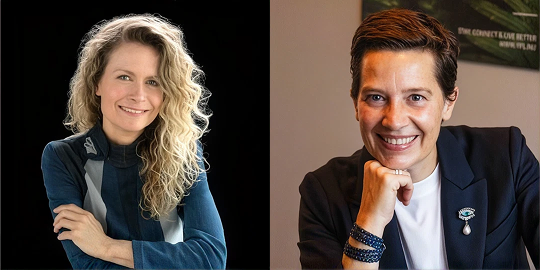
A contagious passion, turning ideas into concrete numbers, gaining confidence in what you want and do, learning what obstacles are in your path and getting the tools to overcome them; Esther Smit and Steffie van den Bosch learned a lot during the Social Entrepreneurship Course. And due to the often perfect timing of the parts, they also apply a few things in their company.
From real estate to social entrepreneurship: a celebration of recognition
'I started this training because I felt the need to meet social entrepreneurs like myself,' begins Steffie, founder of Young People Living. 'I am in the real estate world, and that is mainly about the economic part of entrepreneurship. If you run a business with a social impact in that world, you can feel quite alone. And doubt struck. Successfully connecting an economic revenue model with a conscious and lasting social impact? This is not common in the real estate world. But for the social entrepreneurs I met during the training. "How delicious," I thought. 'So it's possible!' The first day of the training was already a celebration of recognition, and that has remained so for the entire duration. I am now much more confident in what I do and know how to convincingly convey with the right words what YPL is, what we want to achieve and why.'
“It was as if everything in the course was perfectly chosen for what I needed at that moment. Every time I needed knowledge or tools to take a step into the company, it was just covered in a part of the course.”
The first day: personal breakthrough and new insights
The first day also had an impact for Esther, owner of Remake Society. 'I was looking for a way to develop and challenge myself, to make the step from start-up to scale-up,' she says. 'I wanted to know what the ingredients for success are, but also to know where it can go wrong, so I can avoid those pits in the way.' 'I have already followed several development paths on a personal level. I am close to myself. In the first two days, when it came to the personal, I came to the conclusion that there were still a few obstacles that prevented me from taking the next step. At the first assignment already, I found out that there is a deeper layer that made it clear to me why I do what I do. That was a nice gift and makes me even closer to what I'm doing. I ran into myself that first day, but I also got the tools to get started with it.'
"I would like to learn from fellow entrepreneurs and I am looking for tools to properly structure business growth."
Directly applicable tools: Theory of Change, KPI dashboard & Business Model Canvas
Esther: 'The Theory of Change part really stuck with me. I learned to see opportunities in weaker points in a simple way, and especially the practical application was pleasant. The last meeting of the course was about negotiation, which discussed a way to generate successful outcomes on your negotiations. Those were fun sessions and for me a real eye-opener. So you can say that the first and most recent meeting of the course have had a lot of impact on me, which completes the circle.'
For Steffie, especially the timing was perfect. 'It was as if everything in the course was perfectly chosen for what I needed at that moment. Every time I needed knowledge or tools to take a step in the company, it was just covered in a part of the course.' As an example, she gives the KPI dashboard. 'I have an appointment soon, where providing insight into factual figures is important. And look, we got a section about the KPI dashboard. This provides in figures, side by side, insight into the economic objectives and the social impact we make. It gives me, and everyone else, the tangible and concrete proof that our concept works.'
Another good example is the Business Model Canvas. 'I knew it existed, I worked with it, but I couldn't express the social impact in it. Now I have learned that it is indeed possible, and how. It makes what we are doing with YPL much clearer.'
Esther hooks up: 'I like how Steffie is already implementing so many things in her company. I myself take all the knowledge and skill into my mind, but because I have to hold a lot of balls high, it is still quite difficult to apply everything right away. That does not alter the fact that it is parked for the future.'
From personal growth to business impact
Esther continues: 'I want to make myself strong for my mission. But not at my own expense, or anyone else. I set limits. I am more relaxed and confident in that, partly thanks to the training. My business case is like a house. But I also know that I can't improve the world on my own. If it turns out that we are still too far ahead of our time and society is not yet ready for what we can offer, then I set a limit. I don't need this for my ego, I do it for the world. Everything you learn should be in balance with your personal ideas. Everything stands or falls with the Steffies and Esthers of this world.'
The energy of like-minded people: why the group is so important
Steffie agrees. 'The passion, the motivation, the drive that the social entrepreneurs in our group have gives me a lot of energy. Ignited by the passion of the group, I am teeming with ideas and plans, I look at opportunities to scale up, to create more apartments or even more residential complexes. But I also ask myself the question: what don't I do? What do I leave, so I can do other things. I think this is a very powerful question, which teaches you to have confidence in yourself, but also to have the confidence that you can guard your limits and thus focus on what is really important.'
A permanent network for social entrepreneurs
Both Steffie and Esther regret that the course is almost over. 'I really enjoyed getting a look into the kitchen of other social entrepreneurs, also in the form of company visits, but also in the form of intervisions,' concludes Steffie. 'Being able to spar in confidence about problems and setbacks, but also sharing the successes. I'm going to miss that when the course is over. It might be a nice idea to maintain an intervision group. The contact with my fellow social entrepreneurs makes the course extra valuable for us.'