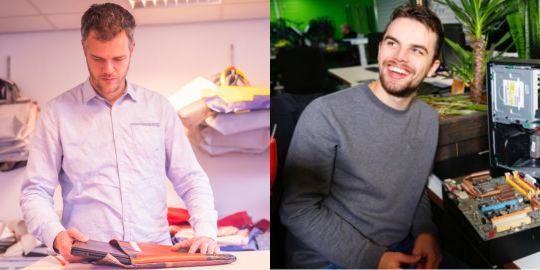
Making culture measurable, putting together the ideal pitch for your company, personal lessons and recognizing and breaking old patterns. The Social Entrepreneurship Course has brought Arie van der Vlies and Thijs Postma many beautiful things that make them stronger as entrepreneurs.
From job coach to social entrepreneur
'I started the apprenticeship because I made the step from job coach to operational director and wanted to have a good foundation for that,' says Thijs. 'In addition to our company, there is also a social enterprise. One of their people had already followed the Social Entrepreneurship Course and was praised about it. The decision was made quickly.'
Arie had known the course for a long time. 'I taught secondary education and also ran a business. That was not yet a social enterprise at the time, so I didn't get much use of the training. That changed when I stopped teaching and started a social enterprise.'
Recognition, recognition and growth
Both agree that the course has brought many good things. Asked what a real highlight was, Arie answers: 'The lessons of Pieter van Osch, about scale-up impact. As a company we want to scale up, and I was wondering how I could hire people who fit the company and me. Just a match with the job profile is not enough. So what else should I pay attention to during job interviews? I have learned to record our culture, to test and accept people on it. Capturing this, making the 'soft side' of the company measurable, really gave me the handle I was looking for.'
That was also a highlight for Thijs in the training. 'And the people with whom you follow the course are of great value to me. You learn a lot from each other. From the first day I felt the recognition. You walk with the same frustrations, the same problems, it's so recognizable. The fact that you are not the only one who runs into certain things was a relief for me.'
More than knowledge: personal lessons from the course
Both have benefited from the setups. 'I've experienced more emotions in two days than normal in a month,' Arie laughs. 'First of all: I am satisfied with who I am. Still, there were things I didn't know I was carrying with me. Weak spots, which make it clear why I do certain things the way I do them, why I react in a certain way. In all honesty, I was a bit skeptical. But it was very valuable, sometimes heavy, but always brought in a light-hearted way. And not unimportant, I have been given the handles to give my weaknesses a place and get started with them.'
Thijs: 'What Arie says is very recognizable. It's nice to learn why you act in a certain way. You learn to recognize logical patterns and see connections in behavior. I was also a bit skeptical about it, but I absolutely see the added value now.'
Arie adds: 'Besides, you learn a lot from others. You are part of someone else's setup, his brother or parent for example. And the reactions you get later from others. Sometimes you think 'I'm the only one with this problem'. To hear around you that others recognize it and have the same problem, that's very nice.'
Profit is not dirty – profit makes social entrepreneurship sustainable
"The fundamental importance of profit." Arie and Thijs agree, that was an eye-opener. Thijs: 'Profit is not a bad word. Many social entrepreneurs have to learn that.' Arie adds: 'I want to make it stronger. Purely formal, it must first be about the profit. If I have to choose, I go for profit. Because profit is sustainable. It ensures that you last longer and can help more people. And that's exactly why you do it.” 'That is why the word 'enterprise' is also in 'social enterprise,' Thijs joins him. Arie agrees: 'Without profit it's not a business, then it's a hobby. And hobbies cost money. Companies make money.'
“Profit is sustainable. It ensures that you can last longer and help more people.”
Leadership with feeling and structure
'To the question of whether they have started to lead differently, Arie says: 'I have come to pay more attention to the soft side. What is the culture within our organization, do the people you want to hire fit that culture? A potential new employee can fit the job profile perfectly, but he or she must also fit in with us as a human being. Since I became aware of the importance of the soft side, I pay more attention to that in job interviews.'
Thijs: 'I just got a little harder. As a job coach I could be a bit looser with people. In the position of operational director, this is less desirable. Nowadays I can also better substantiate my choices, and not just rely on feeling. When we started there was nothing on paper. Capturing goals, strategies and expectations, for example, gives a dot on the horizon, makes results tangible and measurable. And it gives guidance. Now we can make it known what is going well and where bottlenecks are. In short, my leadership has become much more structured. Of course, the feeling is still there,' he adds with a laugh. "I will never become a tough businessman."
Pitching with impact
'The lessons in pitching were special,' says Arie. 'To see how your pitch is flattened, so you can build it up better. Flattened with constructive criticism, I must say. By the trainer and the group. Your pitch will only come out stronger.'
Thijs adds: “You get to know the group better and better along the way. It was nice to see all the loose puzzle pieces of each company together during that last pitch training and what the impact of that is.'
The final of the pitches will be held on November 7. Eight investors are present. 'People who want to invest in social enterprises,' explains Thijs. 'So completely optimizing your pitch is important. Who knows, maybe you're going home at the end of the day with extra money for your business.'
“I'm going to miss the course”
'I regret that the course is completed after November,' Thijs concludes. 'It took time, that's right, and as a social entrepreneur you don't really have plenty of time. But I always looked forward to the school days. You come to beautiful places, speak interesting people. I'm going to miss that.'