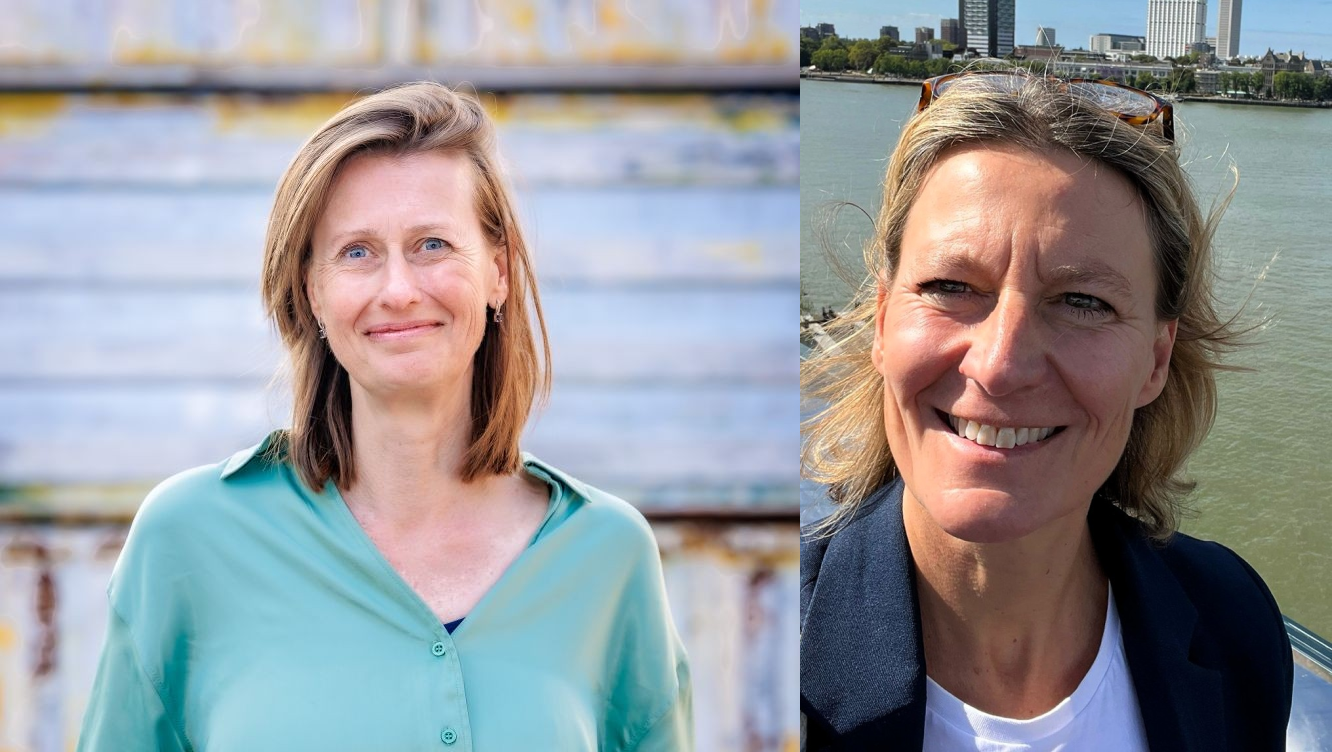
How do you ensure that social ambition within a large organization does not linger in individual initiatives, but leads to structural change? For Antoinette Opstelten (Roterdam Court) and Claartje Aarts (Housing Corporation Portal) that was the key question with which they started the five-day Social Intrapreneurship Course. Both work in organizations where social challenges are great and change is complex. The course not only offered them new insights and tools, but also helped them take a closer look at their role and the impact they want to make.
“You discover that you are not the only one who gets stuck on the same questions. That recognition makes the conversation much sharper. ”
Looking for direction and grip
Antoinette starts when asked why she started the course: 'Basic knowledge and tools to really get ahead with innovations within the company, that's what I've been looking for for a long time. The drive, the will and the ideas to implement changes were there, I needed more information about a proven approach. When I read about the course, I immediately felt the click. That, and the contact with organizations in other sectors. A look in someone else's kitchen is inspiring.'
Claartje was also looking for tools to move forward: 'I have a commercial background, where innovation is more in financial results than in social impact. The word “intrapreneurship” stood out to me. How do you tackle a case on the social level, how do you ensure that it does not become a hobby project and how do you make it measurable and visible in an organization?'
Learning from other perspectives
The group consists of participants from various sectors. That turned out to be an important added value. 'So many people, so many perspectives,' says Claartje. "That's inspiring. There are differences, but also similarities. Such as the drive to implement changes within the organization and the blockages on which you get stuck. That recognition is so nice, the knowledge that you are not the only one struggling with certain things.'
According to her, that diversity makes it possible to get to the core faster: 'It makes it possible to have a conversation about the same issue from different perspectives. You go into depth faster, can go into details better and come to a solution more easily in that way.'
Antoinette adds: 'As an organization, you often follow your familiar paths when you run into a problem. It is incredibly inspiring to see that there are also other paths you can follow. I have therefore often looked with great interest at the course of processes in other organizations.'
The dive into the deep: leadership
The leadership part was intense. 'Two days and an overnight stay,' Claartje explains. 'In those days we really went into depth. That was sometimes quite confrontational. You will be held up a mirror.”
That confrontation proved necessary: 'You see yourself doing certain things, but you don't always know what the effect is on others, the organization and on yourself, nor what to do to break that pattern. I really needed that confrontation to become aware of my preferred modes, so that you can become more flexible in it.'
From Insight to Application: Theory of Change
Although the course has only recently been completed, Claartje and Antoinette already apply the insights in their daily work. Both are called the Theory of Change.
'I immediately started drawing up a model,' says Claartje. 'I also bring a colleague with me. Quite exciting, I have to master the methodology even more. But I definitely see the added value.'
For her, that value is mainly in the conversation that arises: 'Not so much to fill in all the boxes, but more to start a valuable discussion. For this I also use the game that was provided in the course, the toolkit 'Creative Talent works'.'
Antoinette recognizes that: 'That's exactly why I started it already. The model is a good way to start a discussion and thus get the right topics on the table.'
In addition, she works with stakeholder analyses: 'For that I use the game, which contains good questions to draw up the analysis. It is an accessible and valuable way to which everyone in the organization is open.'
Step out of your bubble
The course invites you to look at your own organization from a distance. Antoinette: 'Thanks to the course, you will look at your organization differently. Who and what are you as an organization, what do you want and what do you need for that?'
For projects such as Wijkrechtspraak op Zuid, this is essential: 'In my daily work I am less concerned with this, but in processes with which I want to bring about changes, these are important questions that need an answer.'
She continues: 'At first we found it strange that this analysis was already discussed on day one in the first lesson. In retrospect, it makes a lot of sense. It is a basis for change, for creating impact.'
Claartje adds: 'A stakeholder analysis? Yes, I can... you think. Until you get to work on it, ask someone else critical questions or until you understand the importance of that analysis for your project. Then it suddenly turns out to be much more complicated and valuable than you thought.'
Storytelling: taking people into change
Asked if there are any other models they use, Claartje and Antoinette answer at the same time: 'Storytelling.' Claartje: 'Words are important. Much more important than I thought before I started the course. We tend to think in facts and tables, in results. In doing so, we forget the story.'
That story is crucial: 'The story is precisely necessary to get people with you. Without manpower, nothing happens. People are the energy, the driving force in an organization or a project.'
Antoinette adds: 'Giving the right words to a message. In doing so, you have to take into account the differences between people within your organization. One benefits more from words, while the other prefers to see tables, diagrams and numbers.'
Intense and valuable
Claartje and Antoinette agree: the course was intensive, confrontational and above all valuable. The recognition, the handles, the tools and the models contribute to strengthening their role as a change agent and to the social impact they want to achieve.